LEED projects have gotten faster in a lot of ways. Energy modeling tools are more powerful. Simulation runtimes have dropped. Climate and site data is easier to access than ever. The technical analysis side of certification has genuinely improved over the past decade.
Documentation has not kept up.
The Real Bottleneck
Every LEED credit requires more than just an analysis result. It needs a narrative. It needs evidence. It needs to be organized in a way that a reviewer can trace back to a source. For a typical Gold-level project, that means assembling submittal packages for 30 or more credits, each with its own format and requirements.
Most consultants spend more time on documentation than on the analysis itself. A week of technical work often turns into three weeks of writeups, evidence collection, and formatting. That ratio has stayed roughly the same for years, even as the analysis tools got better.
Where the Time Actually Goes
If you have worked on LEED submittals, this list will look familiar:
- Searching through shared drives for evidence files uploaded months ago
- Digging through email chains to find the right version of a document
- Reformatting the same calculation result into three different credit templates
- Updating every related credit narrative when a drawing revision comes in
- Cross-referencing fixture schedules against baseline calculations by hand
- Rewriting narratives after reviewer comments, often for the same underlying data
None of these tasks require deep technical expertise. They are repetitive, pattern-based, and time-consuming. And they are the reason documentation takes longer than analysis.
The Pattern Behind the Problem
The interesting thing about LEED documentation is that it is not unstructured. Every credit has a defined set of requirements. Every submittal follows a known format. The evidence types are predictable. The narrative language has conventions.
In other words, there are clear patterns. And where there are patterns, there is room for automation.
Consider what happens after an energy simulation completes. The raw results exist. The baseline comparison exists. The percentage improvement can be calculated. But turning that into a credit narrative still requires a person to open a template, copy numbers, write explanatory text, and attach the right supporting files.
The same is true for water efficiency calculations, daylight analysis results, material documentation, and dozens of other credits. The data is there. The translation step is what takes the time.
What Automation Can and Cannot Do
Not every part of LEED documentation can be automated. Projects have unique conditions. Some credits require professional judgment. Reviewer interactions will always need human attention.
But a significant portion of the work falls into categories that are well-suited for automation:
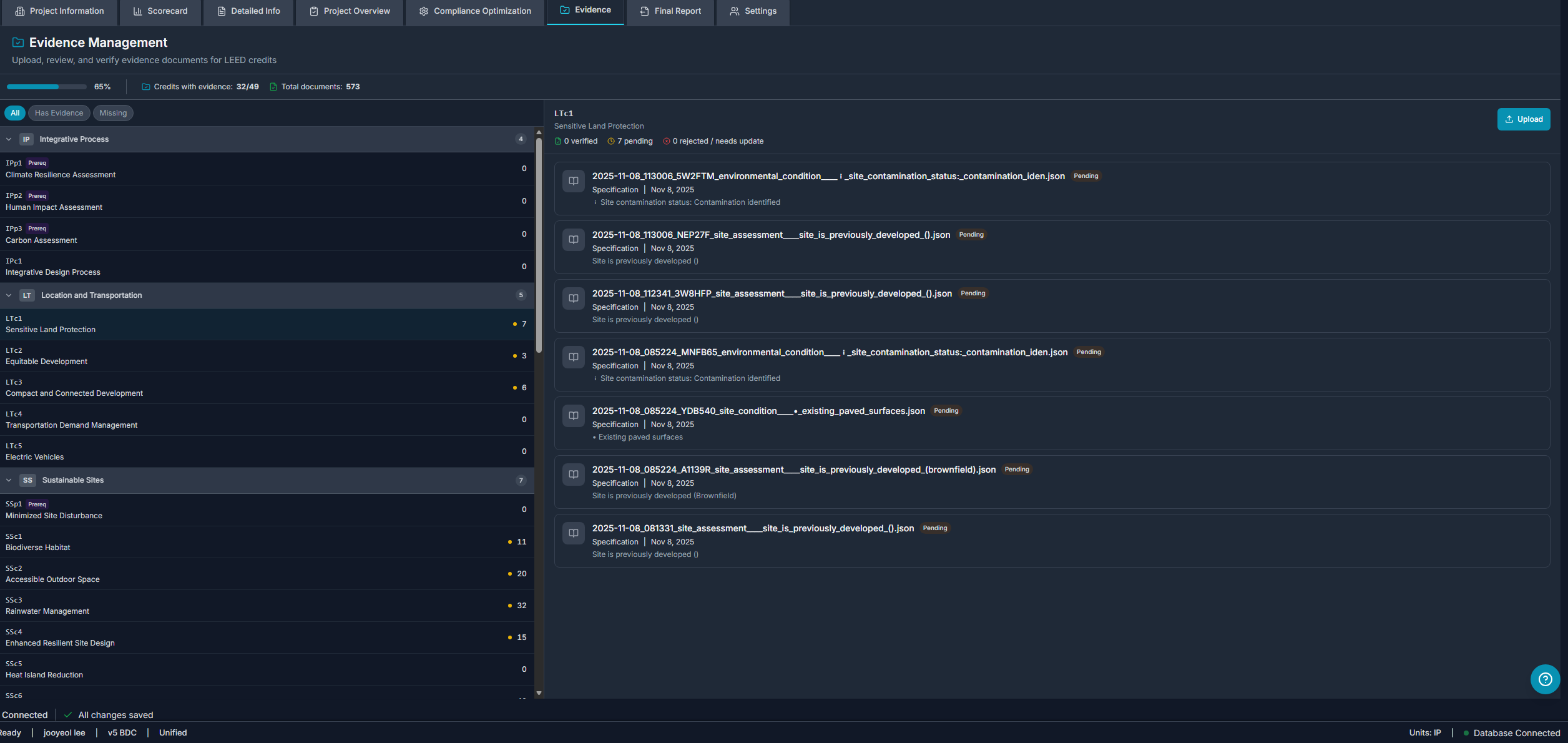
- Evidence organization — tagging documents to credits at the point of generation, not retroactively
- Narrative generation — producing first-draft submittal language from structured analysis results
- Baseline calculations — applying standard formulas and table lookups without manual cross-referencing
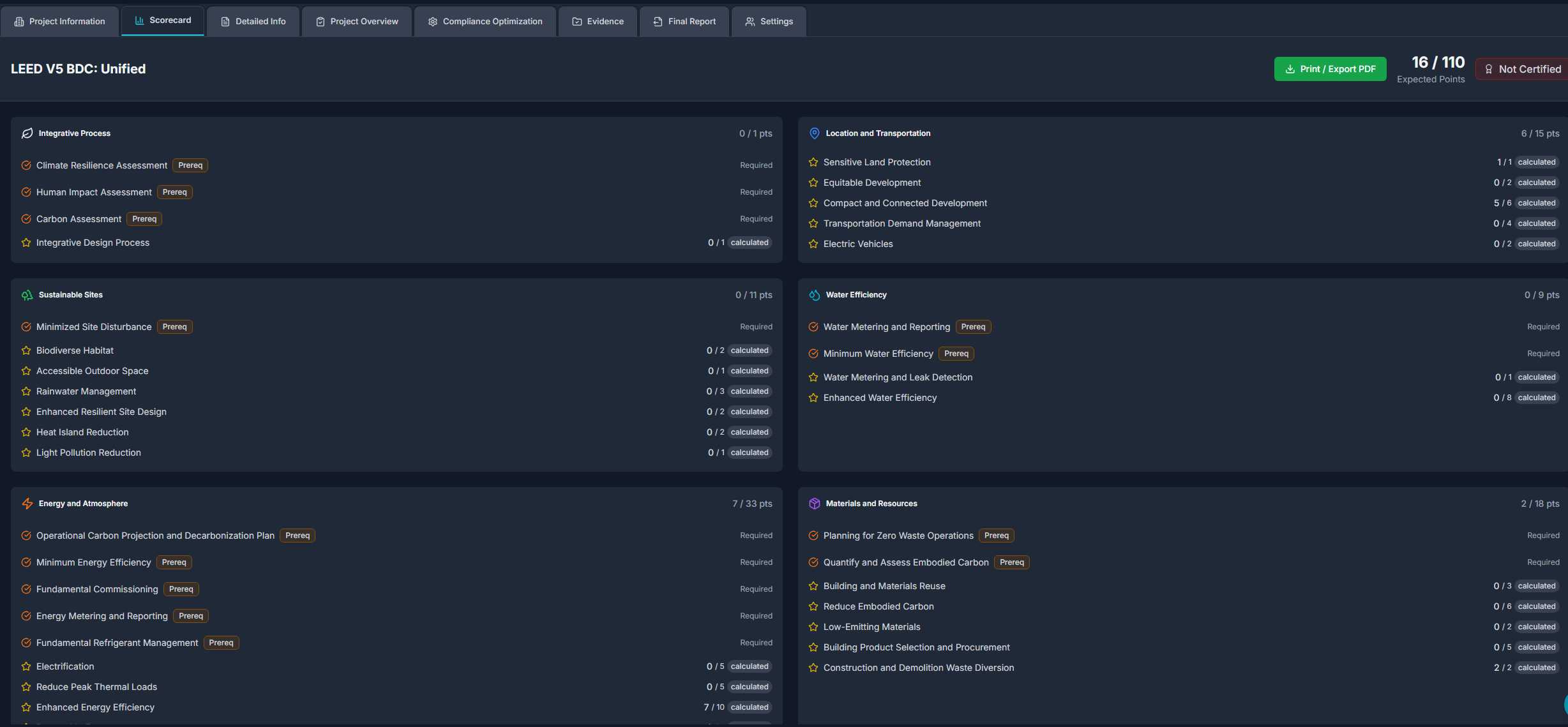
- Credit tracking — maintaining a live view of which credits have sufficient documentation and which do not
- Revision propagation — updating dependent credits when source data changes
The goal is not to remove the consultant from the process. It is to remove the parts of the process that do not require a consultant.
The Industry Gap
Energy modeling has seen substantial investment in automation and tooling. Whole-building simulation, automated baseline generation, cloud-based parametric analysis — these capabilities exist and are actively improving.
Documentation has not received the same attention. Most firms still rely on spreadsheet trackers, manual evidence folders, and word processor templates that have not fundamentally changed in a decade.
This gap is not because documentation is less important. It is because the problem is harder to generalize. Every credit has different requirements. Every project has different conditions. Building a system that handles this complexity reliably is a different kind of engineering challenge than building a faster simulation engine.
But it is a solvable challenge. And the payoff — in time saved, in consistency, in reduced rework — is significant.
Looking Forward
LEED v5 added more prerequisites and expanded the scope of what needs to be documented. Embodied carbon, social equity, climate resilience — these are important additions, but they also mean more documentation work per project.
The industry needs the same level of tooling investment in documentation that it has put into analysis. Not to replace expertise, but to make sure expertise is spent on decisions that matter, not on reformatting spreadsheets.
The firms that figure this out first will have a meaningful competitive advantage. Not because they skip steps, but because they spend their time on the right steps.