LEED projects do not lose time to CFD itself. They lose time to CFD claims that fall apart in review.
A flashy simulation result with a confident color contour goes into the submittal. A reviewer asks where the assumption came from. The consultant searches through old emails, opens the simulation file, realizes the case used a default setting that was not actually appropriate for the room geometry, and now the credit needs a rerun. Two weeks gone, sometimes more.
The problem was never that the simulation tool was too slow. The problem was that the simulation tool let the consultant present a result it could not actually defend.
The Hidden Cost of Fake Precision
Most CFD tools used in LEED workflows are general-purpose engineering packages. They are powerful, but they assume the operator knows which outputs are defensible and which are not. For experienced CFD engineers, that is fine. For LEED consultants who are not full-time CFD specialists, it is a trap.
Pretty contour plots are easy to generate. They look authoritative. They get pasted into submittals because the alternative is leaving an air quality credit thin on evidence. But the contour plot from a default simulation is rarely backed by validation against the specific room geometry, the specific HVAC configuration, or the specific contaminant case the credit actually requires.
When a reviewer pushes back, the consultant pays for that gap. Not the tool vendor.
Why VERTIQ Keeps a Tight CFD Scope
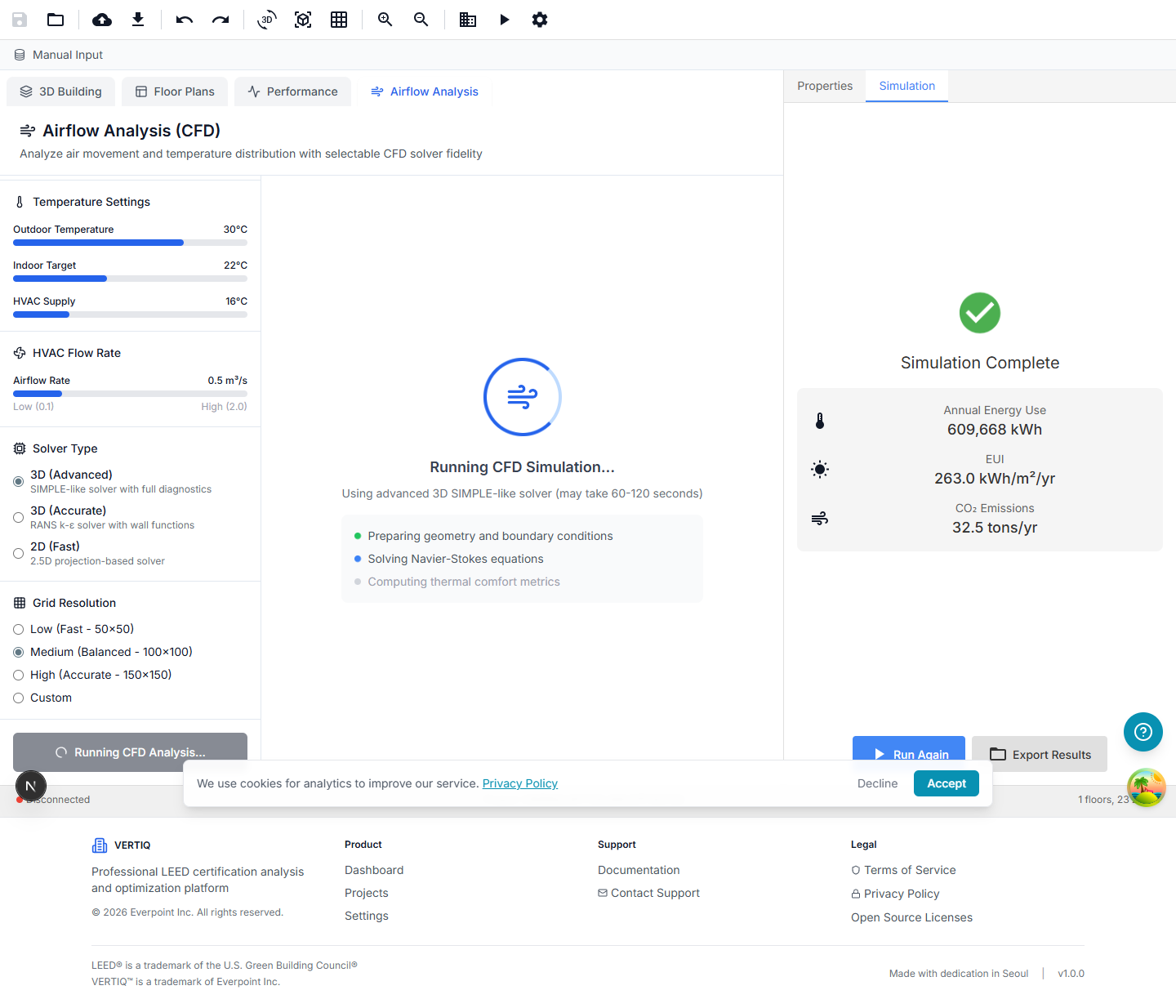
VERTIQ's indoor airflow solver is intentionally narrow. It is built around the physics that actually shows up in LEED workflows:
- HVAC supply jets and room mixing patterns
- Displacement ventilation and stratification
- Buoyancy-driven plumes from heat sources
- Contaminant scalar transport for EQ air quality cases
- Pressure-driven openings between zones
Things that are out of scope: aircraft external aerodynamics, combustion, multiphase flow, supersonic shocks, large-scale exterior wind-domain studies. If a credit needs those, the right answer is to bring in a specialist tool. VERTIQ will not pretend.
The tight scope is a feature, not a limitation. It is the reason setup takes minutes instead of days, and it is the reason the assumptions the solver makes are simple enough to explain to a reviewer in one paragraph.
What "Validated" Actually Means Inside VERTIQ
Two lanes, clearly labeled.
Promoted gates are simulation outputs that VERTIQ treats as strong enough to support reviewer-facing discussion when the source, assumptions, and tolerance are included. These outputs have been checked against external reference data with actual numeric tables, and the solver is regression-tested on them before release. Mean velocity profiles, jet centerline behavior, room mixing results in cases where the underlying paper provided real measurements.
Diagnostic-only outputs are simulation results that are useful during engineering review but are not promoted as defensible product claims. Contour visualizations without underlying measurement tables. Turbulence variance fields that depend on modeling choices we have not yet committed to. Exterior wind cases that the solver does not have the boundary machinery to resolve.
| Safe to reference in reviewer-facing analysis | Keep as design diagnostic |
|---|---|
| A result tied to source-backed numeric validation | A result based only on visual contour similarity |
| A captured assumption set and reproducible project input | A one-off solver setting that cannot be traced later |
| A limited claim about indoor airflow behavior | A broad claim about fully validated CFD accuracy |
Diagnostic outputs are still useful. They help you understand what is happening in your case during design. They guide HVAC layout decisions during integrative process work. They just do not belong in the submittal evidence package unless their source, assumptions, and validation status can be defended.
Where VERTIQ CFD Fits in the LEED Workflow
For most LEED projects, the CFD value is concentrated in a few specific places:
- EQp2 Fundamental Air Quality and EQc1 Enhanced Air Quality. Ventilation effectiveness, mixing behavior, and contaminant decay in occupied zones.
- EQc2 Occupant Experience. Thermal comfort and occupant experience design checks, including buoyancy and stratification in spaces with significant solar gain or process heat loads.
- IP Integrative Process. Early-stage layout decisions when HVAC and architectural design are still being coordinated.
That is where the promoted gates point. Outside those credits, CFD becomes easier to misuse as submittal-grade evidence, and VERTIQ is honest about that boundary.
How Discipline Saves Project Time
The reviewer's question is always the same: where did this number come from? A submittal that can answer that question with a specific, traceable lineage moves through review quickly. A submittal that hand- waves does not.
The useful CFD output is the one whose assumption set can be traced: the project inputs, the solver setup, the output being claimed, and the external reference used to justify that level of confidence. When the reviewer asks, the answer should live in the project record, not in your memory.
Diagnostic-only outputs should stay inside engineering review rather than becoming credit narrative evidence. The product direction is to keep that boundary visible, so a design diagnostic does not accidentally become a reviewer-facing claim.
If the case does require a rerun, you change inputs in the workspace and rerun from the same project context. You should not have to reconstruct the simulation from old notes, because the assumptions should have been captured the first time.
What VERTIQ Refuses to Claim
Some of these will look like weaknesses. They are intentional.
- VERTIQ does not claim to be a general-purpose CFD package. If your credit requires exterior wind loading or smoke transport modeling, use a specialist tool.
- VERTIQ does not promote contour-only validation results. Pretty pictures are diagnostic, not defensible.
- VERTIQ does not use the phrase "fully validated" in marketing copy. The validation system has explicit boundaries, and we name them.
- VERTIQ does not replace OpenFOAM or other research-grade CFD tools. It is a building-workflow solver, not a research environment.
The reason to refuse those claims is simple. The consultant carries the risk when a reviewer challenges a submittal. VERTIQ's job is to give the consultant evidence that holds up under that challenge, not to maximize the feature list on a marketing page.
The Companion Piece
For the engineering side of this discipline, including how the promoted-versus-diagnostic split is enforced inside the validation system and what the team refuses to commit to as accuracy gates, see the engineering-focused companion post The Benchmark Trap: How Validation Discipline Reshapes a CFD Solver.
If you are running a LEED project and want to see how the boundary shows up inside an actual workflow, inspect how the CFD assumptions are attached to the project record before using the result in a reviewer-facing workflow. Those assumptions are the first thing a reviewer will eventually ask about.